Scrabble
Words are laid out in letter tiles on a shared board, each new one built onto what is already there.
15×15 board
A gridded board with premium squares and a marked centre.
The premium squares are laid out symmetrically and work only once — on the turn a tile is first placed on one. That is where the whole positional struggle comes from: take the triple word yourself, or keep the other player from reaching it.
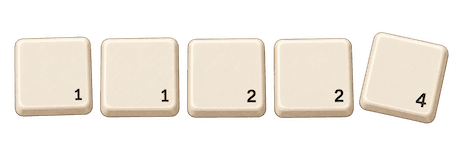
Letter tiles
Under these rules: Around a hundred tiles and a few star jokers.
Tiles carrying a letter and what it is worth in points.
The make-up of a set is not trim but the balance of the game. How many vowels are in the bag, how many rare letters and what they cost follows from the frequencies of the language, which is why the Russian and English sets cannot be reduced to one another. A blank tile with no letter stands for any letter, but brings no points itself.
Rack
A strip on which a player keeps their tiles hidden from the others.
It holds seven tiles in a row and keeps them out of sight. A hidden hand is half the game: an opponent sees the board but not what you are able to answer with.
Rules of Erudit
The set
A board fifteen by fifteen, around a hundred letter tiles and a few star jokers. Each player takes seven tiles onto a rack; the rest form the reserve.
The first turn
The first word is laid across or down so that one of its letters covers the centre square.
Later turns
Every new word joins or crosses the words already laid, forming one grid. Words read left to right and top to bottom. After a turn the player draws back up to seven tiles.
A player who does not want to or cannot make a word may exchange any tiles and so miss the turn.
The joker
A star stands for any letter.
Which words count
Common nouns in the nominative singular are the usual standard. Proper names, abbreviations and hyphenated words are excluded. The dictionary is used to settle a disputed word, not to find a move.
The exact list of allowed forms is agreed by the players before the game.
Premium squares
Coloured squares double or triple the value of a letter or of the whole word. The bonus goes to whoever covers the square first. Letter multipliers apply first, then the word multiplier.
The particular colours depend on the set.
Scoring and the end of the game
A word is worth the sum of its letters, adjusted for the squares; rarer letters cost more.
Play runs either to an agreed total or until the tiles run out. The highest score wins.
Worth knowing
Descriptions differ over the bonus for using all seven tiles: one gives fifteen points, another fifty. The colours of the premium squares depend on the set, and which word forms are allowed is agreed by the players before the game. The disagreement is left as it stands.
Glossary of terms
- Bingo
- A turn that uses all seven tiles from the rack; it earns a bonus of its own.
- Blank
- A tile with no letter on it: it stands for any letter, and scores nothing itself.
- Challenge
- A demand that a word laid down be checked against the dictionary; what follows depends on the code in force.
- Premium square
- A square that multiplies the value of a letter or of a whole word; it works only on the turn a tile is first laid on it.